Sri Krishna Chaitanya Mahaprabhu defeated the Mayavadi scholars by demonstrating that the simple, clear, literal reading of the Vedanta Sutra was self-evident. Their mistake had been to cover this self-effulgent truth by importing into the reading of the text something that is not there in the original. They were culturally conditioned by the idea that the Supreme Absolute Truth must necessarily be impersonal and thus–like the sun obscured by clouds–they could not see what was self-evident in the sutras all along: The Supreme Absolute Truth is the Supreme Personality of Godhead who has unlimited energies which emanate from Him. The Lord converted all these lost souls by his clear explanations of the sutras. The terms mukhya vritti and gauna vritti emerge from this conversation of the Lord with the Mayavadi scholars. Srila Prabhpada explains the distinction here:
“Srila Bhaktisiddhanta Sarasvati Thakura comments that mukhya-vrtti (“the direct meaning”) is abhidha-vrtti, or the meaning that one can understand immediately from the statements of dictionaries, whereas gauna-vrtti (“the indirect meaning”) is a meaning that one imagines without consulting the dictionary. For example, one politician has said that Kuruksetra refers to the body, but in the dictionary there is no such definition. Therefore this imaginary meaning is gauna-vrtti, whereas the direct meaning found in the dictionary is mukhya-vrtti or abhidha-vrtti. This is the distinction between the two. Sri Caitanya Mahaprabhu recommends that one understand the Vedic literature in terms of abhidha-vrtti, and the gauna-vrtti He rejects. Sometimes, however, as a matter of necessity, the Vedic literature is described in terms of the laksana-vrtti or gauna-vrtti, but one should not accept such explanations as permanent truths.” (CC Adi 7.110)
This rule applies to the descriptions of the universe given by Sukadeva Goswami in the 5th canto of Srimad-Bhagavatam. Like the Mayavadi scholars, we have been culturally conditioned by the “scientists” of recent centuries to assume that Earth is a ball-shaped sphere which rotates on its axis and simultaneously orbits the Sun. We have taken in this propaganda with our mothers’ milk. Under such influence we cannot actually hear the words of Sukadeva. We superimpose upon the text something that is not there. We import our material conception into shastra and therefore do not actually “hear submissively”, but rather to the contrary, we insert our ‘spherical spinning earth’ notion into the text in order to preserve our ‘learning’ intact. We think, “surely Sukadeva could not be wrong about the basic fundamentals we held as a priori axiomatic ‘facts’, namely, the theories of Copernicus, Galileo and Newton!” Here is where the deviation occurs.
There is only one Sanskrit word which could possibly be interpreted as stating that bharata-varsha (our known world, commonly called Earth) is spherical like a ball: bhu-gola. Proponents of reading ‘sphere’ into this term are in error. It is in their reading of this single word that their thesis for a detached globe-Earth lay. But who amongst the Vedic sages has called upon us to defend Copernicus? Actually what they are doing is trucking into the Bhagavatam foreign goods. Bhu-gola is used synonymously with Bhu-mandala, the great earth-circle. There simply is no description in the 5th canto of a spinning-ball ‘earth’ that orbits the sun. This is a case of cultural conditioning causing us to project into shastra that which we want to see there.
[I defer to the in-depth, multi-part analysis of the questions surrounding the term bhu-gola given in this article by Mayesvara dasa of Ireland.]
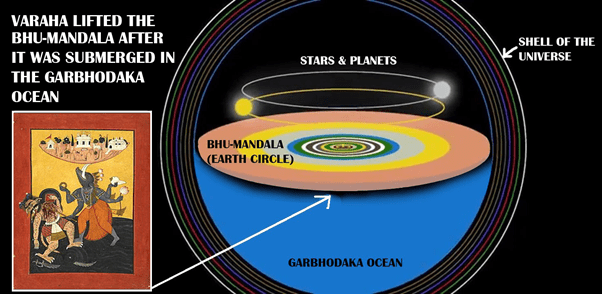
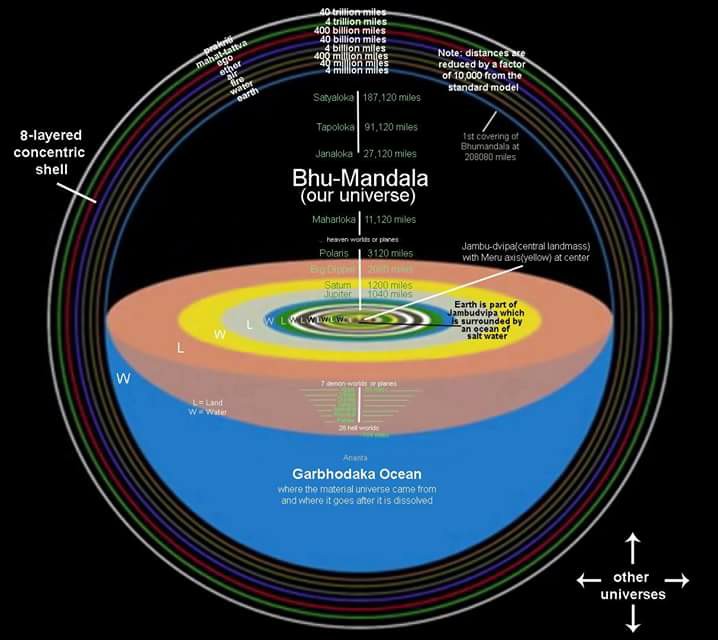
Srimad Bhagavatam–and indeed all the 18 major puranas–are consistent in what they call Earth: bhu-mandala. A continuous, disc-like land mass which cross-cuts the 4 billion mile diameter of the brahmanda, almost touching the first covering of the universe around its edge. Within this bhu-mandala plane, there are variegated features described: Mt. Meru at the center on the island of Jambudvipa, then in concentric rings, the ocean of salt water, then the circular islands and oceans numbering 7 in total. I won’t go into the full description here because I aim to make a specific point about interpretation of the statements of Sukadeva Goswami, the Mahajana.
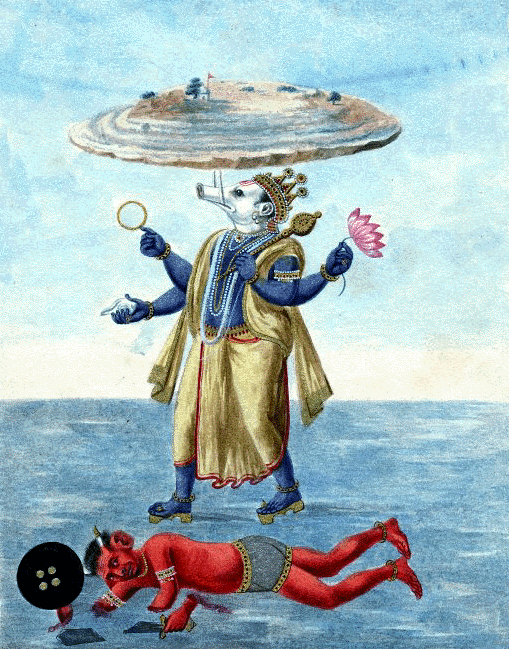
The historically-recent ‘ball-earth’ idea became so pervasive that many artists have rendered Lord Varaha lifting a ball, when in fact he lifted the entire of bhu-mandala, as is clear from the Sanskrit word-for-word given in the text of SB 3.14.31: “bhu-mandalena—by the earth planet”. (The image above was also used in an extensive article on this very topic by Mayesvara dasa of Ireland).
Srila Prabhupada writes in the purport to SB 1.4:
“The original purpose of the text must be maintained. No obscure meaning should be screwed out of it, yet it should be presented in an interesting manner for the understanding of the audience. This is called realization.” [Italics in the original]
Since our cultural conditioning runs so deep, we can’t see that we are bringing in an ‘obscure’ meaning. We are superimposing our preconceived notion over the words of Sukadeva, but this simply covers the self-evident truth just as clouds interrupt our vision of the sun.
Only when we clean the wax from our ears, only when we clean the dirty things from our hearts, and only when we reject the evil notions of the cheating scientists; only then can we hear what Sukadeva Goswami is saying and use it as the proper basis for our conception of the universe.
In the words of Sukadeva Goswami, you will not find that bharata-varsha is distinct or disconnected in any way from the great Earth-circle, bhu-mandala. Nor will you hear that bharata-varsha or bhu-mandala ever move, rotate or spin! There is consistency with the descriptions of Sukadava in Srimad Bhagavatam and the entire span of the 18 major puranas. Outside of the rarely used term bhu-gola and bhu-golaka (synonyms for bhu-mandala) you will never hear anything except the brahmanda itself described as spherical. Since the term gola can be taken to mean spherical or round like a circle, there appears to be logic in choosing ‘spherical’, but this is done at the cost of denying the authority of entire body of the 18 major Puranas. Please think on this deeply.
If we follow a policy of rejecting certain statements of Sukadeva Goswami because they don’t line up with the imperfect vision provided by our gelatinous eyes, where will we stop? How can we pick and choose amongst the statements of the son of Vyasadeva who was a liberated soul before his birth, the sage who spoke to the emperor of Jambudvipa, Pariksit Maharaja, when he was preparing for death? Can you imagine Srila Prabhupada allowing the rejection of even a single verse spoken by Sukadeva Goswami?
Many formerly disconnected things begin to fall into place by embracing the direct meaning, the mukhya-vritti. Here is just a single example: In describing various benefits derived by worshipers of various deities in SB 2.3.2-7, Sukadeva Gosvami states “One who desires stability in his post should worship the horizon and the earth combined.”
How can that which is worshiped confer a property it does not itself posses?
I propose that this is the starting point for all honest devotees: Accept Srimad Bhagavatam As It Is including the description of our known world as a portion of bhu-mandala, the great Earth-circle. If we want to do further research in an attempt to clear up apparent contradictions between the Puranic descriptions and our ant-like sense-experience, I have no objection, so long as we keep the mukya-vritti of shabda brahman in its proper place at the foundation of our knowledge-acquiring-process, as we were taught by our Founder-Acharya His Divine Grace A.C. Bhaktivedanta Swami Prabhupada.
Srila Prabhupada writes in the purport of SB 8.2.6:
“In the higher planetary systems, there are not only different types of human beings, but also animals like lions and elephants. There are trees, and the land is made of emeralds. Such is the creation of the Supreme Personality of Godhead. Śrīla Bhaktivinoda Ṭhākura has sung in this regard, keśava! tuyā jagata vicitra: “My Lord Keśava, Your creation is colorful and full of varieties.” Geologists, botanists and other so-called scientists speculate about other planetary systems, but being unable to estimate the varieties on other planets, they falsely imagine that all planets but this one are vacant, uninhabited, and full of dust. Although they cannot even estimate the varieties existing throughout the universe, they are very proud of their knowledge, and they are accepted as learned by persons of a similar caliber. As described in Śrīmad-Bhāgavatam (SB 2.3.19), śva-vid-varāhoṣṭra-kharaiḥ saṁstutaḥ puruṣaḥ paśuḥ: materialistic leaders are praised by dogs, hogs, camels and asses, and they themselves are also big animals. One should not be satisfied with the knowledge imparted by a big animal. Rather, one must take knowledge from a perfect person like Śukadeva Gosvāmī. Mahājano yena gataḥ sa panthāḥ: (CC Madhya 17.186) our duty is to follow the instructions of the mahājanas. There are twelve mahājanas, and Śukadeva Gosvāmī is one of them. svayambhūr nāradaḥ śambhuḥ kumāraḥ kapilo manuḥ prahlādo janako bhīṣmo balir vaiyāsakir vayam (SB 6.3.20)
Vaiyāsaki is Śukadeva Gosvāmī. Whatever he says we consider to be factual. That is perfect knowledge.”

 VEDASONIC