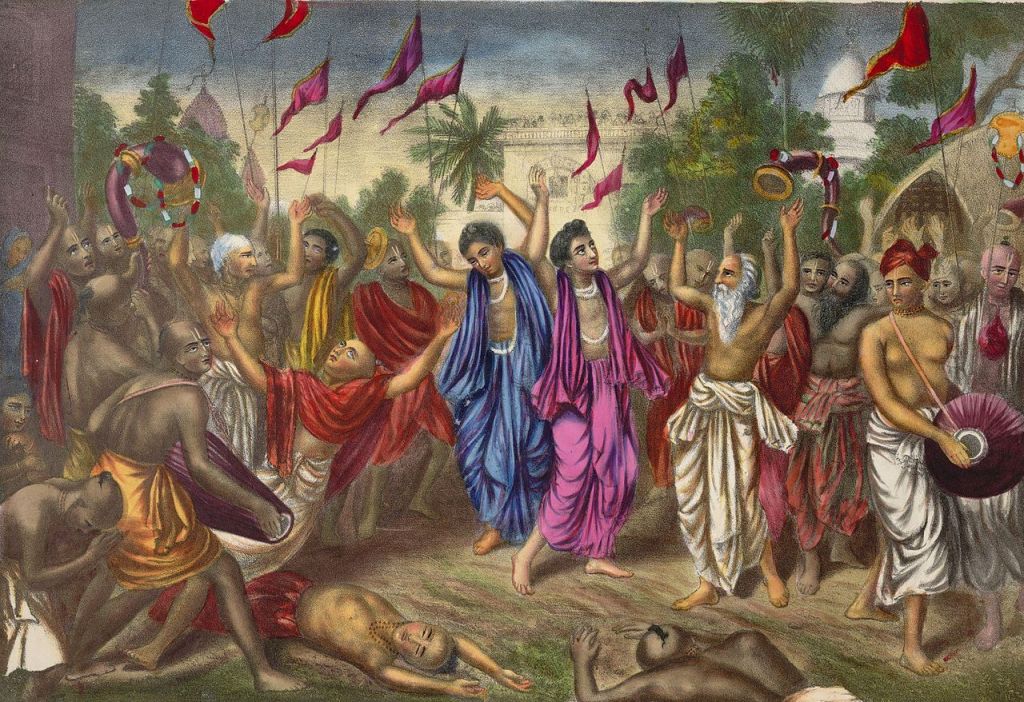
Krishna prema (love for God) is the ultimate necessity of every living soul (imagine a dot at the center of a circle). Actions, knowledge and conditions that bring us closer to Krishna prema are also necessary (this corresponds to the area within the circle). Actions, knowledge and conditions that move us away from Krishna prema are unnecessary and undesirable. (Imagine arrows outside the circle pointing away from the center dot). In this analogy there are two necessities that are legitimate requirements for a human being: (1) Krishna prema, and (2) Pious civilization that enables progress to this stage. Other modes of life go against the purpose of creation and result in misery and degradation.
I want to identify this dot (at the center of the circle) to the cosmology presented in the Srimad Bhagavatam versus the planetary motion formulas presented in Surya Siddhanta (representing the area within the circle). In their sincere search to understand the mysteries of the Vedic universe, many devotees are conflating the value of these two sources of revealed knowledge.
Indeed, they seem to talk about the same planets, in the same universe, but there is a gulf of difference between these two texts. They differ in rank and context, but in the end, their purposes are in harmony.
Rank and context?
They are both texts in the Vedic tradition but let us consider their provenance. They are both revelations from divine beings of higher status to enlighten ordinary humans. One should disparage neither. However, one should be understood to clearly out-rank the other.
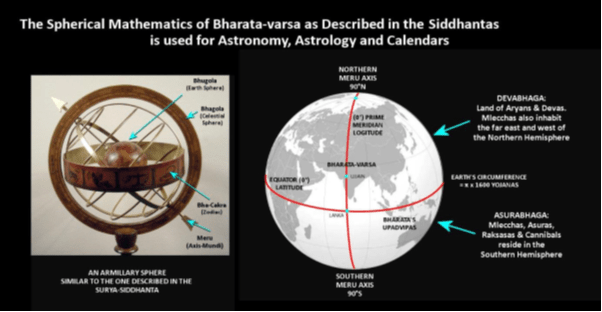
Surya Siddhanta is the record of a conversation between the empowered expansion (amsa) of the Sun god and the demon king Maya-danava. He propitiated the sun god by his austerity and as a result the sun god became pleased to reveal the knowledge that the demon desired. This knowledge is an extremely detailed download of mathematical formulas which are practical and functional in predicting the precise locations of any planet at any time. This includes solar and lunar eclipses, the equinoxes, retrograde motion, and hundreds of other details. Part of this methodology involves conceiving of Earth as a sphere with lines of longitude and latitude in order that the formulas give the desired outcomes. In Surya Siddhanta there is almost zero philosophical content present regarding the nature and purpose of human life. Nor is there any claim to the physical reality of what is being described. The only given guarantee is technical accuracy in timing and position of heavenly bodies from a geocentric viewpoint. This is extremely useful for creating accurate calendars by which the masses can take advantage of auspicious timings for rituals, worship, festivals, marriages, etc. Civilization requires astronomy and astrology which are legitimate sciences that support gradual progress of humanity from lower to higher stages of realization.
On the other hand, Srimad Bhagavatam is teaching the highest possible goal for the human being, namely, pure love for Krishna–free from the contamination of karma and jnana. It was spoken by the liberated sage Sukadeva Goswami to the saintly king Parikshit, who had only seven days in which to understand the essence of all knowledge before death. Lord Chaitanya praised Srimad Bhagavatam as the spotless purana. Jiva Goswami proved in his Sandarbhas that it is the highest authority amongst all Vedic literatures. In it’s second verse, Vyasadeva announces: “Completely rejecting all religious activities which are materially motivated, this Bhāgavata Purāṇa propounds the highest truth, which is understandable by those devotees who are fully pure in heart. The highest truth is reality distinguished from illusion for the welfare of all. Such truth uproots the threefold miseries. This beautiful Bhāgavatam, compiled by the great sage Vyāsadeva [in his maturity], is sufficient in itself for God realization. What is the need of any other scripture? As soon as one attentively and submissively hears the message of Bhāgavatam, by this culture of knowledge the Supreme Lord is established within his heart.”
Purpose?
Based on rank these text could hardly be further apart, however, they both share the purpose of serving the legitimate necessities of human beings. These are:
(1) Unalloyed love for Krishna as the perfection of self-realization (Srimad Bhagavatam), and;
(2) To support ritual religious progress toward this ultimate end (Surya Siddhanta).
The author A.K. Ramanujan posits that Indian thought tends to be context-sensitive, whereas, Western thought seeks context-freedom. Ramanujan provides a good framework for this question as we attempt to harmonize the reality of the jyotish viewpoint with that of Srimad Bhagavatam.
I assert that these are both valid viewpoints when applied to their intended purpose. Conversely, the one has little utility for the purpose of the other. An example may clarify what I mean. Jyotish astronomical calculations can aid in knowing the precise day and time according to the sun or the moon. You can therefore create a horoscope for a child and guide his educational path according to his indicated varna and ashrama. You can know where the sun, moon and stars will appear in the sky using the spherical Earth concept and the concept of the ‘celestial sphere’. This knowledge does not, however, equip us with a map to travel by land, air or sea. Jyotish was not revealed to man by the gods for this purpose!
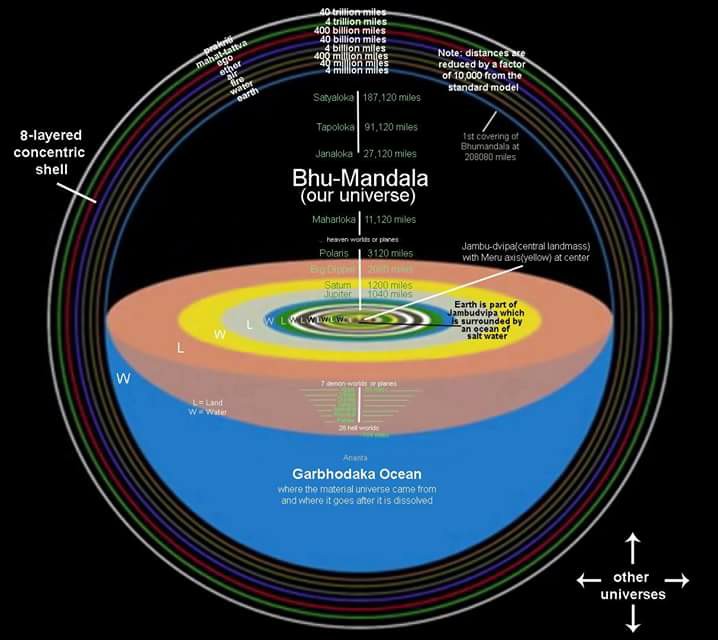
On the other hand, the Puranic ‘map’–given in the 5th canto– is actually navigable by land, air and sea. Indeed, Maharaja Parikshit himself had traveled North in his conquest of all the nine varshas of the island of Jambudvipa of which he was sovereign:
“Mahārāja Parīkṣit then conquered all parts of the earthly planet-Bhadrāśva, Ketumāla, Bhārata, the northern Kuru, Kimpuruṣa, etc.-and exacted tributes from their respective rulers.” SB 1.16.12
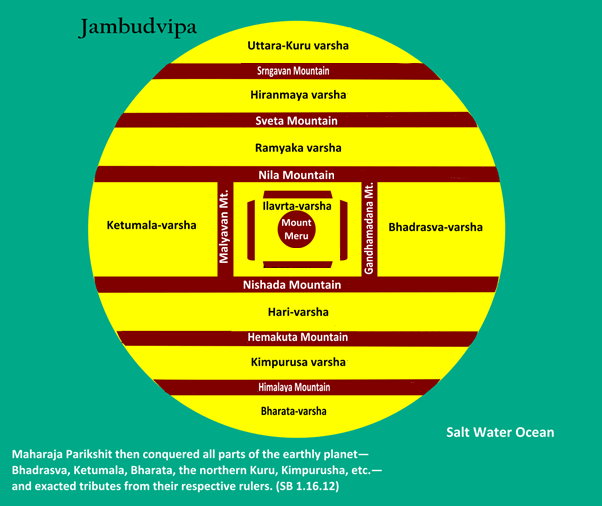
[The image of Jambudvipa above appears in an essay by Mayesvara dasa who elaborates on these topics.]
Also, Parikshit’s grand-uncle, Maharaja Yuddhisthira is mentioned as the ruler of the whole of Jambudvipa. In the Sanskrit of the verse below, the word used is jambudvipadhipatyam which indicates Yudhisthira’s sovereignty over all nine varshas of Jambudvipa.
“News even reached the celestial planets about Maharaja Yudhisthira’s worldly possessions, the sacrifices by which he would attain a better destination, his queen, his stalwart brothers, his extensive land, his sovereignty over the planet earth, and his fame, etc.” (SB 1.12.5)
Western thinkers want to take a context-sensitive type of knowledge and try to stretch it beyond it’s intended purpose. Their idea is to boil all truth down to a formula that you could print on the front of a t-shirt: A single formula that would apply in all times and places. This typifies context-free knowledge. Jyotish is not a travel map, however, as it cannot be used to send rockets to the planets that roam overhead. It has it’s circumscribed purpose in creating calendars, advising persons based on their natal charts and all progressive religious human necessities. The effort to ‘stretch’ the revelation of jyotish into a navigable ‘map’ of reality fails.
Remembering that we are tiny jiva souls–1/10,000th the tip of a hair in size–let us be grateful for the descent of knowledge from the divine realm to our very humble position. By the grace of the Supreme Lord, we are given our necessities. Prayojana means necessity. We should be grateful for the divine statements of the Bhagavatam just as we are grateful for the air that we breathe and the food that sustains us. Even given our limited capacity to comprehend the cosmos, the Lord is so kind that he gives us concentrated information beyond our capacity: Our cup runneth over! The Vedas provide liberal instructions and guidance toward not only the good, but especially the best.
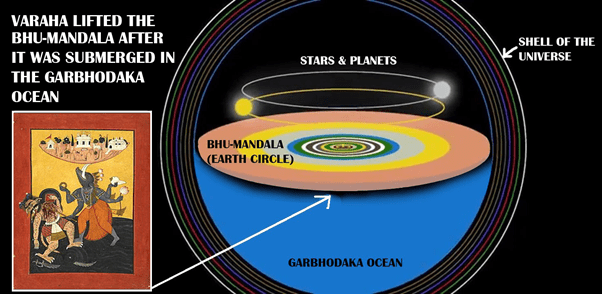
It is in this context that I propose we create our ‘map’ of the universe. For the purpose of ultimate reality, the Puranas (and specifically the Srimad Bhagavatam) provide the accurate map. Not only are we informed by this ‘map’ that the Earth upon which we live is non-different from the body of our beloved Lord, but ultimately, we are placed here for the purpose of reviving our lost relationship and regaining our long-lost true love.
The fact that a conceptual sphere is used in the mathematical calculations required for Jyotish should not distract us from the higher guiding principles of the Bhagavatam. I am not even saying that Earth is both flat and round simultaneously. I am saying that because we are limited beings, we are fully dependent on the great divine beings to provide us with context-sensitive knowledge that serves our necessities. For the purposes of our senses, the world is physically ‘flat’ as described in the 5th canto. Bharata-varsha (what we call ‘Earth’) is contiguous with the larger ‘flat’ landscape of bhu-mandala. Yet, for the purposes of astronomical and astrological calculations, the Earth can be considered ‘mentally’ spherical.
While the conceptual uses differ, it is interesting to note what the Puranic and Jyotish descriptions have in common: Earth is immovable, fixed in the center of the universe and it neither spins nor orbits.
Why has modern ‘science’ propagated so many lies in regard to their so-called space adventures and conquests? This is the nature of the anti-gods, the asuras. They will not accept the authority of Supreme Personality of Godhead, Krishna, or his authorized line of disciples.
Only because of greed to dominate and lord over nature does one go beyond these two necessities that I have delineated (ultimate and progressive). By the misuse of revealed knowledge for purposes of exploitation of nature and violence done to God’s children, we are cast into the abyss of illusion. In this state of illusion we are condemned to see up as down and down as up. Nothing will be successful if we go beyond what we need. This applies to our physical necessities as well as to our thirst for knowledge. It is natural to be curious about the world. I was born curious! However, when we receive the authoritative answers, we should be grateful and satisfied.
Remember that at the beginning of his description of the universe, the great Mahajana Sukadeva Goswami made this statement, providing a general ‘disclaimer’:
“The great ṛṣi Śukadeva Gosvāmī said: My dear King, there is no limit to the expansion of the Supreme Personality of Godhead’s material energy. This material world is a transformation of the material qualities [sattva-guṇa, rajo-guṇa and tamo-guṇa], yet no one could possibly explain it perfectly, even in a lifetime as long as that of Brahmā. No one in the material world is perfect, and an imperfect person could not describe this material universe accurately, even after continued speculation. O King, I shall nevertheless try to explain to you the principal regions, such as Bhū-goloka [Bhūloka], with their names, forms, measurements and various symptoms.”
Indeed, the desire to fully and completely know everything is tantamount to desiring the position of God. Only God knows everything, and we should be happy and satisfied to be in a favorable relationship with God. We can be completely self-satisfied and blissful as servants of God. Otherwise we will be lost in the labyrinth of unknowability, suffering in the cycle of birth and death. The Vedas warn us to turn from this darkness and go to the light.
tamasi ma jyotir gama
Srimad Bhagavatam is presenting the Supreme Absolute Truth, the Supreme Personality of Godhead, Krishna, while Surya Siddhanta plays a supporting role for progressive spiritual development in human life. The light of the Vedas shines brightly to illuminate our minds and save us from the darkness of ignorance. The Vedas shine with a common purpose to elevate human beings from the lower modes of tama-guna and raja-guna to the mode of sattva-guna and beyond. Between the Srimad Bhagavatam and Surya Siddhanta, this overarching common purpose creates harmony. However, in order to profit from each, their utility must be seen contextually.
A subway map will not guide you to heaven; Nor should a personal audience with God be wasted in asking for an upgraded prison cell.

 VEDASONIC