This question may appear to answer itself, however, it is a worthy topic of discussion. According to the Acharyas, including Rupa Goswami and later Visvanatha Chakravarti, faith deepens in eight distinct stages from thin to thick as a practitioner makes progress from initial faith to pure love of Godhead; from ‘srhaddha’ to ‘prema’.
Another type of progression that Srila Prabhupada very often called out is the gradual understanding of Krishna’s intimate Vrindavan pastimes with Mother Yashoda, the cowherd boys and the milkmaids. He emphatically declared that only by progressing systematically through the ten books of the Bhagavata Purana, starting with book one and progressing through all nine prior books, can one have any hope of comprehending the Supreme Personality of Godhead in the fullness of his exchanges of rasa with the gopis. He also compared the early books to the Lotus Feet of the Lord and the tenth book to Krishna’s smiling Face.
How then, can one who rejects the direct words of Sukadeva Goswami regarding the universal map in the fifth canto have full faith in the descriptions he gives about Krishna’s private life in the tenth?
By rejecting a portion of the Srimad-Bhagavatam, I would suggest that a practitioner is acting without full trust and thus his faith is not sufficient for the development of prema. Notice that Srila Prabhupada’s faith in the fifth canto topics was equal to his faith in the tenth canto topics. Can we say the same of modern devotees who prefer the descriptions of the universe given by asuric leaders and their space agencies?
But didn’t a devotee scientist acknowledge that the fifth canto “could be true” by modifying the direct statements of Sukadeva into an externally-suggested interpretation based on mathematical similarities between modern astrology and the fifth canto, finally concluding that bhu-mandala corresponds to the solar-system’s ecliptic plane? Further, didn’t he suggest that therefore ordinary humans cannot perceive bhu-mandala because it exists, but only in a ‘higher dimension’?
How is ‘it exists, but only in a higher dimension’ functionally different from ‘it is imaginary’? Did Sukadeva describe the universe using three-dimensional metrical units or four-dimensional metrical units?
In any case, if the conclusion involves effectively covering the direct words of the Mahajana Sukadeva Goswami, how is this different from the work of the great Shankaracharya, who covered the direct meaning of Vedanta with an unrelated explanation. Lord Chaitanya preferred the mukhya-vritti –the face value or dictionary meaning of the words spoken by Vedic authorities. Sukadeva, although acknowledging the difficulty of the subject matter in an initial disclaimer, continued to use ordinary language and ordinary worldly dimensions understandable by human beings to describe the map of the Lord’s creation. He never cautioned Maharaja Parikshit that this was only comprehensible by sages, advanced yogis or gods. He also explained that he was repeating exactly what he heard from his spiritual master (Vyasadeva).
It would be unwise to pit the direct words of the highest Vedic shastra (Bhagavatam) against hearsay provided by materialistic scientists. A devotee in the line of Srila Prabhupada should aspire to the same level of faith that he exhibited. Bhagavad-Gita As It Is. How about Srimad-Bhagavatam As It Is?
Conclusion:
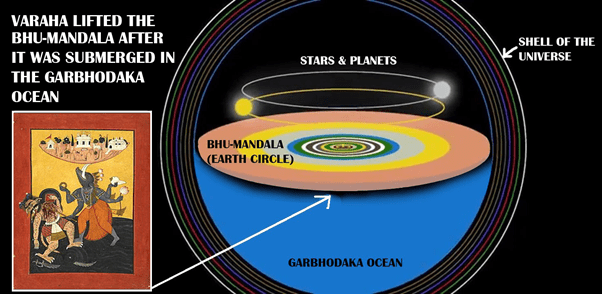
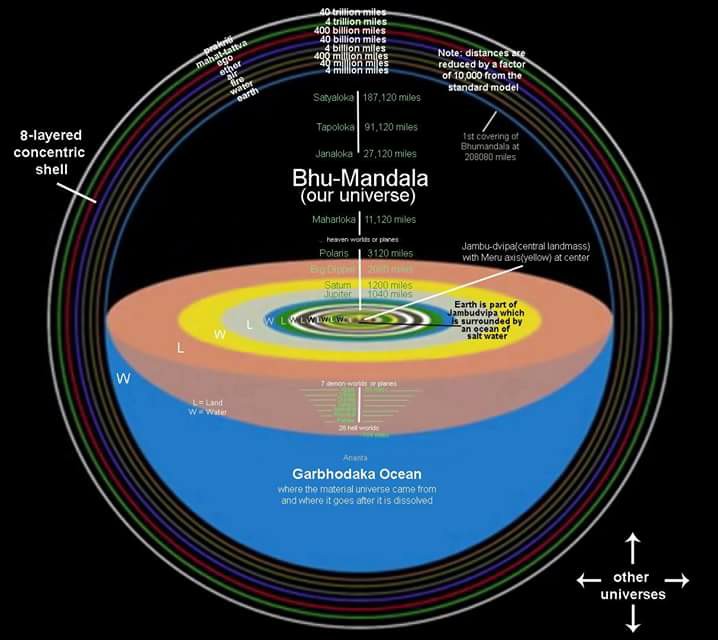
Earth is not a spinning ball that circles the sun, but rather our known world–consisting of the seven continents– is a tract of land at the southern-most division of the central island of jambudvipa, that is in turn, connected to the great earth-circle bhu-mandala. This is so because it is described this way in the authoritative shastra Srimad-Bhagavatam which explains things that are beyond the perception of our senses. Shastra is apaurusheya, meaning that it is beyond the four defects found in ordinary human speakers. Sukadeva Goswami, the speaker of Srimad-Bhagavatam is counted among the twelve Mahajanas. Heaven and hell are also described in this shastra, but we do not reject them because they are not visible to our gelatinous eyes. In the same way, we accept the description of bhu-mandala and our location thereupon without un-neccessary word-changes or interpretations. There is no mention by Sukadeva Goswami of a spinning sphere that orbits the sun, in fact the very opposite is presented: The sun, moon and other luminaries circum-ambulate the fixed polestar which is centered above the fixed and immovable bhu-mandala Earth-circle below. Therefore, Earth is not a spinning ball that circles the sun, rather the place we live is bharata-varsha, the southernmost division of the central island of jambudvipa on the fixed landmass of bhu-mandala. It neither spins nor orbits. Earth is fixed and non-moving, and–excepting mountains and valleys–it is generally a four-billion mile diameter flat circular disc.

 VEDASONIC